Czech-Japan Hub connects business, innovation, culture, and talent across both countries. We pair deep knowledge of the local landscape with direct access to the people who actually make decisions – on both the Czech and Japanese side, with reach into European structures. We turn a single meeting into a lasting partnership.
We are a strategic platform, not an agency and not a traditional chamber. We complement the public trade and investment agencies on both sides and add what they cannot offer: personal introductions, Expert Working Groups, cultural diplomacy, and a single coordinated counterpart operating in both legal systems at once. We accompany projects between Czech and Japanese partners from first contact to concrete result – in business, culture, sport, talent development, and regional cooperation.
We run targeted partner searches, B2B matchmaking, market research, trade missions, and trilingual Business Desk support. We connect you with the specific companies that match your strategy.
We open doors for companies to universities and research institutes in both countries – for joint development, cooperation, and recruitment. And we help talented students and young professionals towards internships, professional growth, and careers in the Czech-Japan space.
We produce events with a business dimension: VIP receptions, artistic collaborations, and sport diplomacy. This is how the trust Japanese business expects is built. In Japan, culture is not a supplement to business; it is the ground business stands on.
We guide partnerships between Czech cities and regions and their Japanese counterparts – from the first introduction to the delivery of concrete projects.
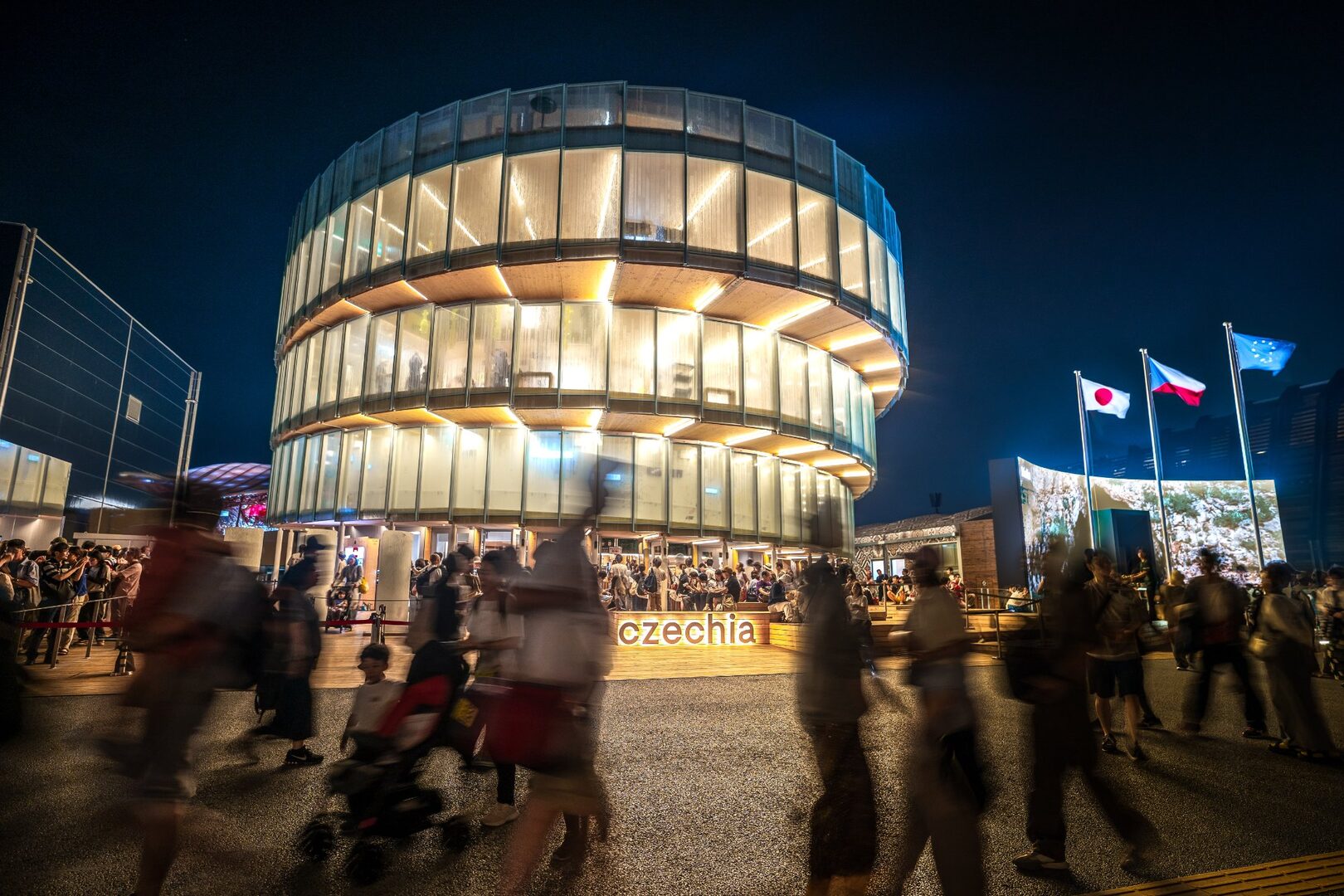
Czech-Japan Hub grew out of one of the most successful Czech presentations abroad. EXPO 2025 Osaka showed how much potential lies between Czechia and Japan – in trade, innovation, culture, and talent.
Relationships built at EXPO need systematic care. Without it, the energy fades within 12 to 18 months. Czech-Japan Hub is the structure that keeps these relationships alive and turns them into results.
We operate as two coordinated legal entities – a registered association in Czechia and an Ippan Shadan Hojin in Japan – forming one bilateral platform.
The Czech government decides to take part in the World Expo 2025 Osaka, Kansai and appoints Ondřej Soška Commissioner General. The first partnerships with Japanese institutions take shape. An open architectural competition for the Czech pavilion is launched.
An international expert jury chaired by renowned architect Eva Jiřičná selects the winning pavilion design by Apropos Architects. The demanding process of preparing design documentation and securing its approval in Japan begins. We present the concept across Czechia and Japan and start building a robust network of Czech and Japanese partners.
We unveil the national pavilion in virtual reality. Following a tender, the construction contract is signed. Most of the load-bearing structure and the entire glass facade are made in Czechia. In Japan, there are doubts that such a complex building can be finished on time. Within three months, however, the structural shell stands – roughly a month ahead of the official schedule. Major partners and sponsors join.
The Czech Pavilion is the first foreign pavilion visited by Japanese Prime Minister Shigeru Ishiba. On Sunday 13 April, the gates of EXPO 2025 Osaka, Kansai open. The Czech Pavilion becomes one of the most visited European pavilions.
The ROBOT Expedition of six vintage cars arrives in Osaka, having covered more than 14,000 km in the footsteps of the 1970 Sakura Expedition. On 24 July, marking the 165th anniversary of the birth of painter Alfons Mucha, we celebrate the Czech National Day with Her Imperial Highness Princess Takamado, President Petr Pavel, and other distinguished guests.
EXPO closes. The Czech Pavilion welcomed over 1.5 million visitors, hosted dozens of business conferences and VIP guests from around the world, presented more than 500 Czech artists in Japan, and connected over 100 Czech companies with Japanese counterparts – dozens of new business partnerships emerge. The pavilion earns a series of awards: 1st place in the visitors' vote, 2nd place for architecture, 2nd place for best mascot, and the European Union award for hospitality. The Japanese entity of Czech-Japan Hub is officially established and introduced at the Business After EXPO event in the Czech Pavilion.
Czech-Japan Hub is officially presented at the Czech Embassy in Tokyo.
The Czech entity of Czech-Japan Hub is established; the first members join and the Expert Working Groups are formed.
The Ambassador of Japan, H.E. Kansuke Nagaoka, hosts a reception to thank the partners and organising team of the Czech participation at EXPO 2025. The Hub introduces itself to the partner community in Czechia.
We are preparing new events for you right now. In the meantime, see what the most recent ones looked like. And subscribe to the newsletter so you don't miss the next ones.
Nearly 400 international and Japanese business leaders, 23 Chambers of Commerce, the Mayor of Osaka on stage for the first time, and a clear message for international companies: Osaka city can offer almost everything the capital does, at 30 to 50% lower cost. On Friday, 5 June 2026, Czech-Japan Hub was among the co-hosts of the Kansai International Meishi Exchange, and the evening showed that Kansai keeps its doors open to international business.
On Sunday 17 May, Vít Koďousek brought his Ichigo Ichie Live Painting Performance to Ritsumeikan University's Osaka Ibaraki Campus – a single, unrepeatable circle drawn in the middle of one of Kansai's largest community open days.
Ambassador of Japan to the Czech Republic, H. E. Kansuke Nagaoka, hosted a reception at his Prague residence for the partners and the team behind the Czech Pavilion at EXPO 2025 Osaka, Kansai. It was a thank-you to the people behind the largest showcase of Czech business and culture in Japan in decades – and behind a result that is already bringing concrete deals to many participating companies.
Every company or institution that becomes a member by 30 September 2026 receives membership valid until 31 December 2027 – for the price of a single annual fee.
A designation no later member can earn – a permanent place on the Founders’ Wall on the website and in future business centres.
Full access to all Hub services and events from day one until 31 December 2027.
The right to help shape the agenda of the Expert Working Groups in their founding year.
An hour with our team on your goals in the Czech-Japan space, right at the start of your membership.
A closed gathering of the Hub’s founding members at the end of 2026.
On September 16, 2026 the Japan National Tourism Organization (JNTO) published its estimate of foreign arrivals for August 2026: 3,098,900 visitors came to Japan, down 9.6% year on year. The figure can look like the end of Japan's tourism boom, or like the "hangover" after EXPO 2025. But is that what really happened? Break the numbers down market by market and a different conclusion appears.
On 30 July 2026, an agreement of association between the EU and Japan regarding the Horizon Europe programme was signed in Brussels. Japan thus officially became the 23rd associated country in the EU’s largest programme for research and innovation, with a budget of 93.5 billion EUR for the 2021–2027 period. With a population of 123 million, Japan is the most populous associated country. According to the Annual Management and Performance Report for the financial year 2025, by the end of that year approximately 134,000 researchers had participated in Horizon Europe with 22,500 peer-reviewed scientific publications and 10,000 innovative outputs recorded.
Participation in the EXPO 2025 Osaka, Kansai, has delivered measurable business results for Czech companies. This is the finding of a survey by the Czech-Japan Hub association, in which partners of the Czech participation at EXPO 2025 took part. More than a quarter of respondents have already signed specific contracts with Japanese partners, and a further 55 % are engaged in active business negotiations. The survey also confirmed that the culturally strategic approach Czechia chose in Osaka demonstrably accelerates the building of trust with the Japanese side.